
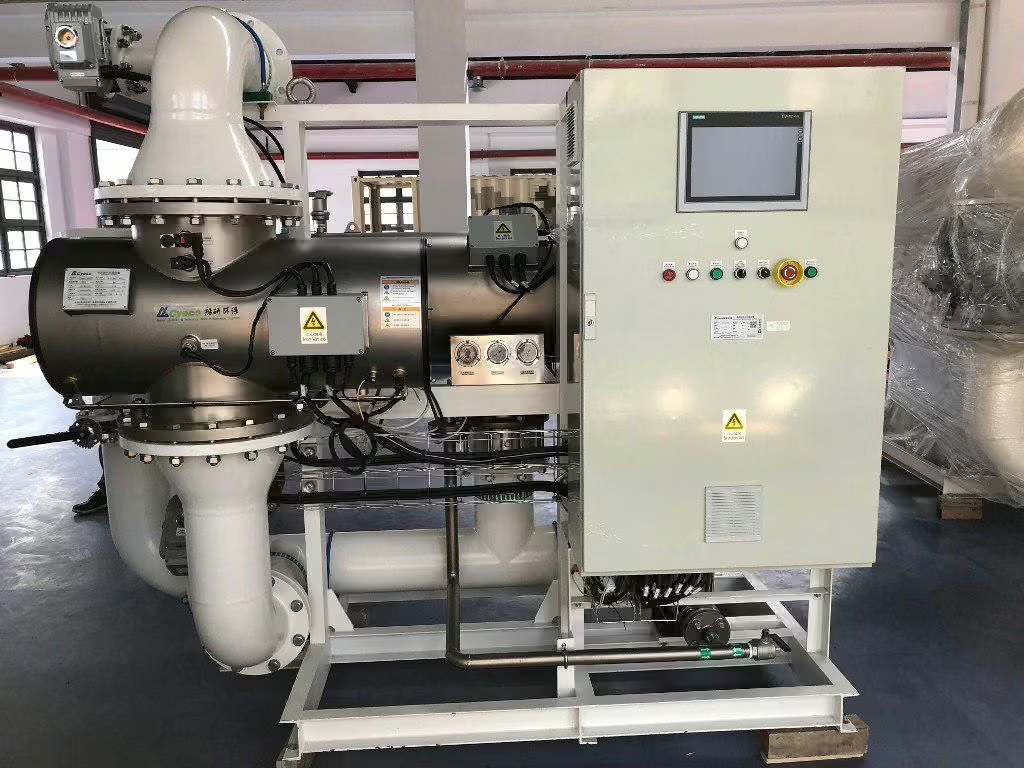
Ballast water treatment systems: purpose, types, operating principles and performance selection
Estimated reading time: 5 минут
Content
- 1 How ballast water treatment systems help preserve ecosystems
- 2 Why is it important to clean ballast water?
- 3 How do ballast water treatment systems work?
- 4 Principle of operation of ballast water treatment systems
- 5 Comparison of different types of ballast water treatment systems
- 6 Why is this important?
- 7 How to choose the performance of a ballast water treatment system
- 8 How do I calculate the required performance?
How ballast water treatment systems help preserve ecosystems
When a ship enters a port, it usually takes in water as ballast — to maintain stability and balance. But this ballast water doesn't just help the ship keep its course. Along with it, micro-organisms, invasive species and pathogens that can disrupt ecosystems on the other side of the planet can be transferred. Ballast water thus becomes not only an important element for ship stabilization, but also a potential threat to ecosystems if it is not treated.
Why is it important to clean ballast water?
To prevent the destruction of ecosystems, the International Maritime Organization (IMO) has adopted strict rules for the shipping industry that require ships to install ballast water treatment systems. These systems not only help to minimize the risks of the spread of invasive species, but also ensure compliance with international environmental standards.
How do ballast water treatment systems work?
All ballast water treatment systems work on similar principles, but use different technologies. Let's look at how each of them functions:
- Filtration and ultraviolet radiation (UV)
Imagine that water is like a large lake filled not only with water, but also with a lot of microorganisms. The filters in these systems resemble a mesh that traps large particles, and then the water is exposed to ultraviolet radiation, destroying microbes. This requires no chemicals and is a fairly eco-friendly approach. - Treatment with chemical reagents
This method uses oxidizing agents such as chlorine, which destroy microorganisms. Water passing through the system reacts with these chemicals, and then the remaining chemicals are neutralized, which prevents environmental pollution. - Electrolysis
This is similar to creating chemical reactions inside water using electricity. Water passes through the electrolyzer, and in the process hypochlorite is formed — a powerful oxidizer that destroys pathogens. The advantage of this method is that you do not need to store dangerous chemicals on board the ship. - Cavitation and ozonation
In these systems, water is exposed to cavitation bubbles, which literally "explode" under the influence of pressure, destroying microorganisms. Or, for example, ozone is used — a strong oxidizer that destroys pathogens at the cellular level.
Principle of operation of ballast water treatment systems
No matter how different the technologies are, they all follow three basic cleaning steps::
- Filtering: Remove large particles such as plankton or debris that may be carried with the water.
- Disinfection: Destruction or inactivation of pathogens by chemical or physical methods.
- Quality control: After cleaning, monitoring is carried out to make sure that the water does not contain harmful microorganisms and chemical residues, and is ready for discharge into the environment.
Comparison of different types of ballast water treatment systems
| Filtration and UV treatment | Treatment with chemical reagents | Electrolysis | Cavitation and ozonation | |
|---|---|---|---|---|
| Eco-friendly | | | | |
| Low equipment and maintenance costs | | | | |
| Easy to operate | | | | |
| Does not require chemicals | | | | |
| High efficiency | | | | |
| Doesn't depend on the filter quality | | | | |
| Does not require neutralization of residual reagents | | | | |
| Independence from the salinity of water | | | | |
| Wide range of actions | | | | |
| Does not require electricity | | | | |
Why is this important?
Ballast water treatment not only helps maintain the balance of ecosystems in different parts of the world, but also minimizes risks to marine ecosystems by preventing the spread of invasive species. With the development of cleaning technologies, the shipping industry is becoming more environmentally friendly, which means that we can all continue to enjoy the oceans without fear of devastating consequences.
As you can see, the technologies behind ballast water treatment systems involve not only complex scientific processes, but also concern for our common future.
How to choose the performance of a ballast water treatment system
When choosing a ballast water treatment system, the key parameter is its efficiency. efficiency, which is determined by the volume of ballast water to be pumped and discharged in one cycle. It is important to consider several factors that influence the choice of the appropriate system:
- Ship size
Large vessels, such as tankers or container ships, require a high-capacity system. These vessels can pump and discharge large volumes of water, and the system must be able to handle such volumes quickly and efficiently so as not to create delays in operations. - Frequency of operations with ballast
If the ship frequently changes ballast water (for example, when calling ports with different water quality requirements), then a system with a high processing rate should be selected. This will allow the vessel to efficiently perform operations without long downtime and delays. - Operating region
In regions with particularly sensitive ecosystems, such as coral reefs or marine protected areas, systems with a higher degree of cleaning may be required. In such cases, it is important to take into account not only the performance, but also the efficiency of cleaning in order to meet local environmental standards.
How do I calculate the required performance?
The capacity of a ballast water treatment system is usually indicated in cubic meters per hour (m3 / h). For the correct choice, it is necessary to proceed from the maximum volume of ballast water that the ship must process in the minimum time. This will help avoid delays in ballast handling operations and ensure smooth operation of the system.
To accurately determine the optimal system performance that is suitable for the specific operating conditions of the vessel, you can contact us. Our specialist will help you choose a ballast water treatment system based on the type of vessel and operating conditions.

Cyeco®Ballast Water Treatment Systems BWTS
We have available for sale Cyeco®Ballast Water Treatment Systems BWTS filtering by means of UV radiation, with a capacity from 200 to 6000 m3/h. Our managers are always ready to help you choose based on your needs.

LEAVE A COMMENT